
When Healing Collides With Old Patterns: A Guide for Estranged Children
Healing is not neat or tidy. It does not come with a warning label. And sometimes, just when you feel ready to start fresh, the past shows up, unapologetic and fully loaded.
I started this year with exactly that. A message from my mother, nine years after no contact, landed like a slap in the face. She sent me an article about estranged children and their “doormat” parents. A thinly veiled attempt to make me feel guilty and shame me. She works vigorously to pull me back into her story of victimhood.
This has only validated my reasoning for walking away in the first place. She does not want to heal. She does not want to grow or reflect. She wants something else entirely. She wants me to feel bad. To feel shame. To feel pain.
The Years It Took to Walk Away
The decision to cut off contact was not sudden. Estranged children do not walk away lightly. For me, it came after many years of navigating a toxic cycle.
Eight years before I made the decision, my father hit my oldest child, who was only two at the time. My mother tried to convince my toddler that it didn’t happen the way he remembered. As heartbroken as I was to watch my childhood now play out in my adult life with my own child, I chose forgiveness. I chose to try again because I wanted a relationship with my family of origin.
Eight more years of cycles, boundaries tested, and repeated disappointment only made one thing clear: I had been complicit in my own suffering by continuing to accept behaviors that were harmful. Walking away was the only way to protect myself and my family from this toxic, abusive pattern. And it is something I should have done eight years sooner.
How Toxic Parents Drain Your Energy
Toxic parents take more than they give. They demand emotional labor, insist on blame, and often thrive on punishment or control. Over years, this slowly erodes your energy, leaving you exhausted and disconnected from your own needs.
Healing after this kind of relationship is not just emotional, it is energetic. This will often feel like scattered energy. Rebuilding that kind of energy takes time and practices that center you.
Step One: Stepping Away
Sometimes, the first step in restoring your energy is physically and emotionally stepping away. This time can allow for you to:
Reclaim your emotional and physical space
Reconnect with your inner guidance and intuition
Release cycles of blame, shame, or guilt
Rebuilding Your Energy
Energy healing can support this process in profound ways. Some practices that helped me:
Grounding rituals: connecting to nature is deeply healing for me. I spent many days walking along the beach as I worked to release years of old, painful energy.
Energy clearing: Using visualization or meditation to release lingering toxic energy from your field
Intentional self-care: Nourishing your body, mind, and soul in ways that feel restorative
Setting sacred boundaries: Clearly defining what you will and will not accept, and holding that boundary consistently
Over time, these practices rebuild the energetic foundation that toxicity tried to erode. They remind you that your energy is precious and yours to protect.
Walking Away Is Not Easy
Estranged children do not leave lightly. Walking away from a parent goes against the grain. But sometimes, the most radical act of love is claiming your freedom and refusing to participate in cycles that harm you or your loved ones.
Toxic parents may try to punish, shame, or manipulate, but when you are grounded in your healing, their attempts no longer dictate your energy. You are free to evolve and to thrive on your own terms. It is a reclamation of self and only you can give yourself that gift.
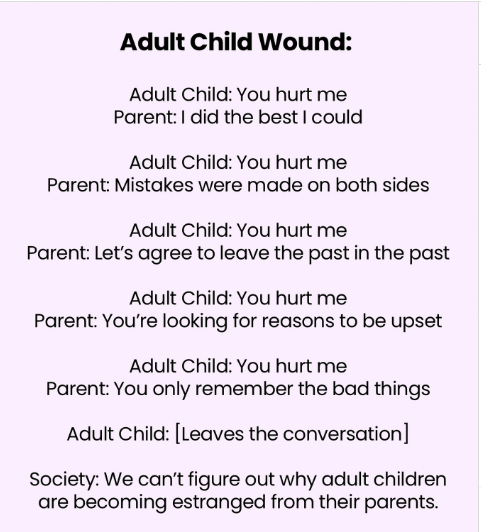
When an adult child says, “You hurt me,” it is not an attack, it is an attempt to be seen and understood.
When a parent responds with defensiveness or minimization, it does not heal, it deepens the wound. Phrases like “I did the best I could” or “Let’s just move on” might sound harmless, but to the child, they often mean: “Your feelings don’t matter.”
True repair is not about arguing over who suffered more. It begins with listening, acknowledging, and taking responsibility for the impact of your actions.
Healing across generations starts the moment one person chooses understanding over defense.